Abstract
Generative AI may be improving access to courts. But is it improving access to justice? A new paper analyzing roughly 2.8 million federal civil filings from 2008 to 2025 finds a sharp rise in self-representation and signs of AI-assisted drafting — yet no corresponding improvement in outcomes. Access to legal drafting is not the same as access to a legal remedy.
Access to courts is not access to justice
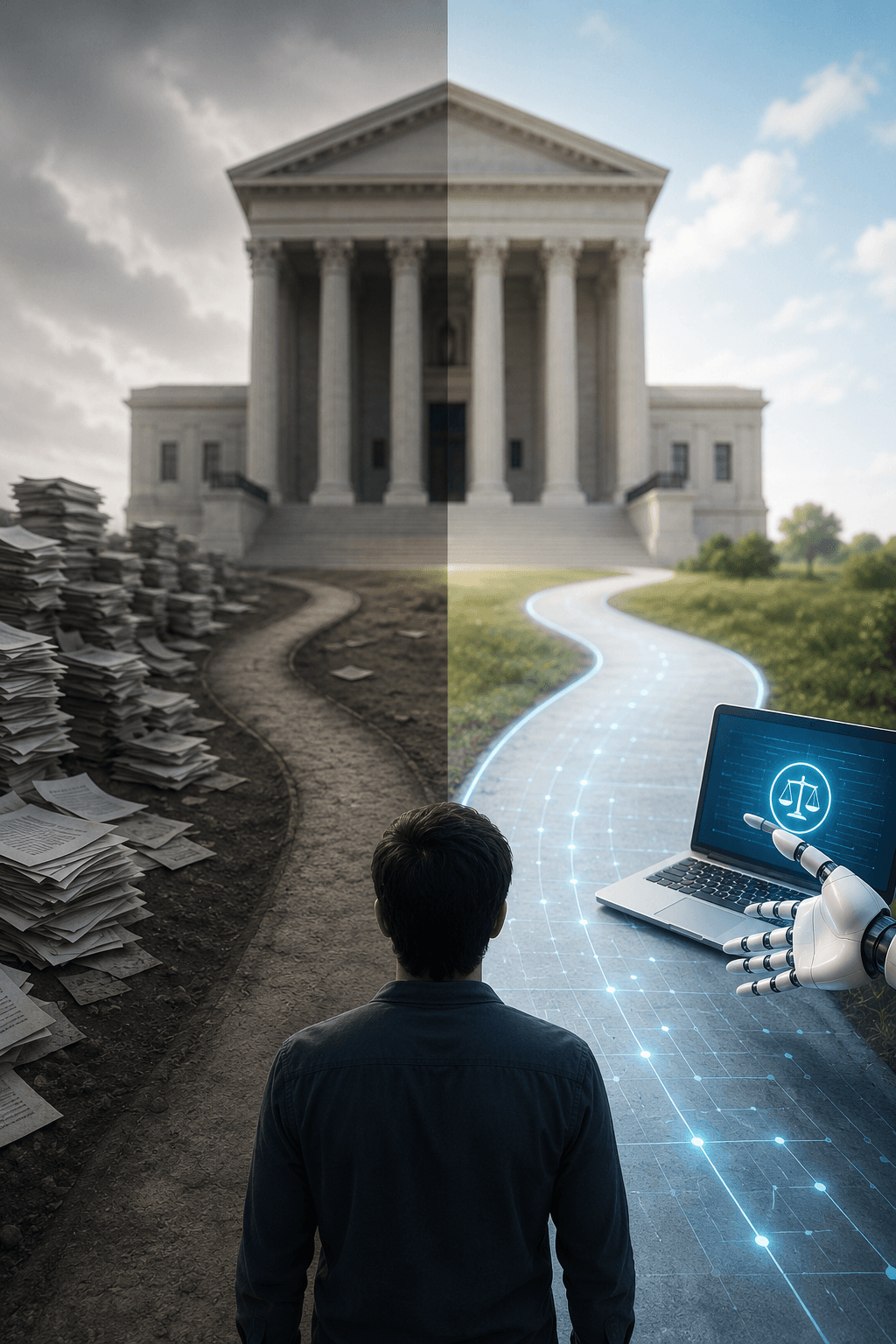
Generative AI may be improving access to courts. But is it improving access to justice?
A new paper, The New Pro Se: Generative AI and the Surge in Federal Civil Self-Representation, analyzed approximately 2.8 million federal civil filings from 2008 to 2025.
The findings are striking
The data points to a measurable shift in both the volume and the appearance of self-represented litigation after generative AI became widely available.
- The share of federal civil cases filed by self-represented plaintiffs increased from 11.33% before widespread GenAI access to 16.94% afterward — an increase of almost 50%.
- Among post-GenAI non-form complaints, approximately 13.9% showed drafting patterns consistent with AI assistance.
- Those complaints were generally more polished and contained more legal citations.
Better-looking pleadings did not produce better outcomes
AI-flagged complaints had a higher dismissal rate — 61.1% compared with 53.6% — were more likely to end at an early procedural stage, and showed no advantage in win rates.
This highlights a critical distinction: access to legal drafting is not the same as access to a legal remedy.
What AI can and cannot do
Generative AI can help someone organize their story, identify legal concepts, and produce a document that looks like a formal complaint.
But it cannot automatically create jurisdiction, establish sufficient facts, preserve a claim within the statute of limitations, produce admissible evidence, or transform a genuine grievance into a legally viable cause of action.
The study does not prove that GenAI caused the increase in self-representation. However, it provides significant evidence that the rise of public AI tools is associated with changes in both the volume and appearance of pro se litigation.
An opportunity and an institutional challenge
For individuals who cannot afford a lawyer, AI may make the courthouse more accessible. For courts, however, increasingly polished but legally deficient filings may require more time to review, understand, and dismiss.
The solution should not be to prevent self-represented litigants from using AI. It should be to develop better guided tools, stronger legal-aid systems, effective court triage, and meaningful opportunities for human legal review.
Access to filing, or access to justice?
AI may be lowering the barrier to entering the justice system. The next challenge is ensuring that it also helps people navigate that system effectively.
Are we expanding access to justice — or merely access to filing?
Sources and references
Study analyzing ~2.8 million federal civil filings (2008–2025).